
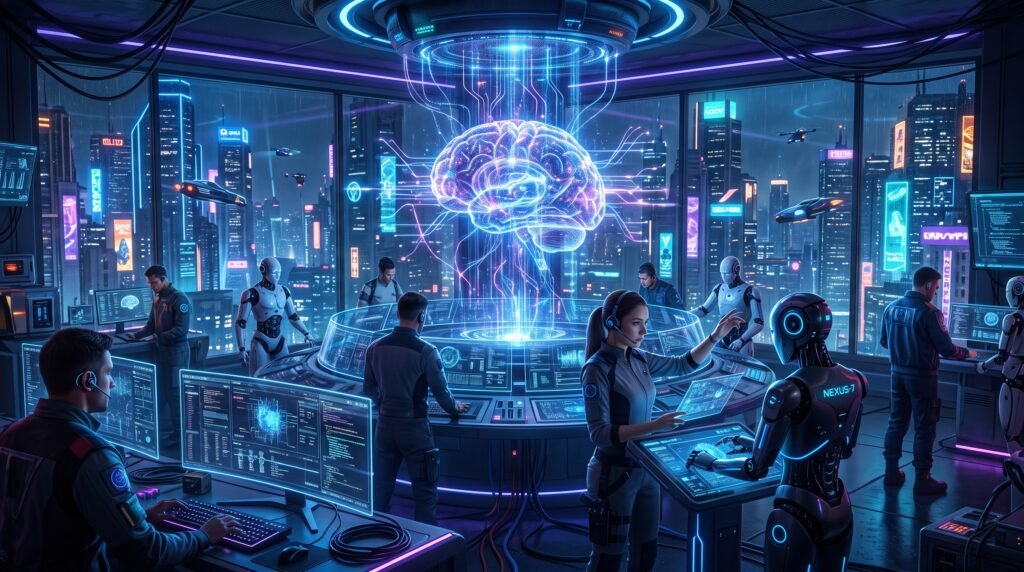
Artificial Intelligence (AI) has evolved from a futuristic concept into an essential part of our daily lives. From virtual assistants and smart healthcare systems to autonomous vehicles and advanced business automation, AI continues to reshape industries around the world. In 2026, AI is becoming more powerful, accessible, and integrated into everyday applications than ever before.
1. AI Agents Are Becoming Smarter
Modern AI systems are no longer limited to answering questions. Intelligent AI agents can now:
- Research information
- Write documents
- Analyze data
- Generate code
- Schedule tasks
- Automate business workflows
Businesses are increasingly adopting AI agents to improve productivity while reducing operational costs.
2. Generative AI Continues to Grow
Generative AI can create:
- Articles
- Images
- Videos
- Music
- Software code
- Marketing content
Content creators, designers, and developers are using AI tools to complete tasks in minutes instead of hours.
3. AI in Healthcare
Healthcare organizations are using AI for:
- Medical image analysis
- Disease prediction
- Drug discovery
- Virtual health assistants
- Electronic medical record analysis
These technologies help doctors make faster and more accurate decisions while improving patient care.
4. Cybersecurity Powered by AI
Cyber threats continue to increase every year. AI helps organizations detect suspicious activity in real time by analyzing millions of data points.
Benefits include:
- Fraud detection
- Malware identification
- Network monitoring
- Automated threat response
AI-powered cybersecurity solutions significantly reduce response times against attacks.
5. Smarter Business Automation
Companies are automating repetitive tasks such as:
- Customer support
- Invoice processing
- Data entry
- HR recruitment
- Sales forecasting
This allows employees to focus on higher-value work that requires creativity and strategic thinking.
6. AI and Education
Education is becoming more personalized through AI.
Students now benefit from:
- Personalized learning paths
- AI tutoring
- Instant feedback
- Language translation
- Interactive educational content
Teachers also use AI to automate grading and create customized lesson plans.
7. AI-Powered Software Development
Developers increasingly rely on AI coding assistants that help:
- Write code faster
- Detect bugs
- Generate documentation
- Improve software quality
- Suggest optimizations
AI is accelerating software development across startups and enterprises alike.
Challenges of AI
Despite its advantages, AI presents several challenges:
- Data privacy concerns
- Bias in AI models
- Ethical decision-making
- Job displacement in some industries
- Responsible regulation
Governments and technology companies continue working to establish guidelines for the safe and ethical use of AI.
What to Expect Next
The next wave of AI innovation will likely include:
- More autonomous AI assistants
- Better multilingual communication
- Faster scientific discoveries
- Advanced robotics
- Improved personalized healthcare
- Enhanced smart cities
- Greater integration with everyday devices
Conclusion
Artificial Intelligence is no longer a technology of the future—it is a driving force behind innovation today. As AI continues to evolve, businesses, educators, healthcare providers, and individuals will discover new opportunities to improve efficiency, creativity, and decision-making.
Organizations that embrace AI responsibly and invest in developing AI skills will be better positioned to thrive in the rapidly changing digital landscape.